What if everything we thought we knew about black holes was wrong? New research suggests that the very fabric of reality around these cosmic monsters might be evolving, challenging a cornerstone of astronomy.
An international team of astronomers, led by the National Observatory of Athens, has unearthed compelling evidence that the material swirling around supermassive black holes hasn't remained static throughout the universe's history. Their findings, published in Monthly Notices of the Royal Astronomical Society, hint at a dynamic transformation in the structure and behavior of this matter over billions of years. If confirmed, this discovery could upend a fundamental concept that has guided astronomical research for nearly half a century.
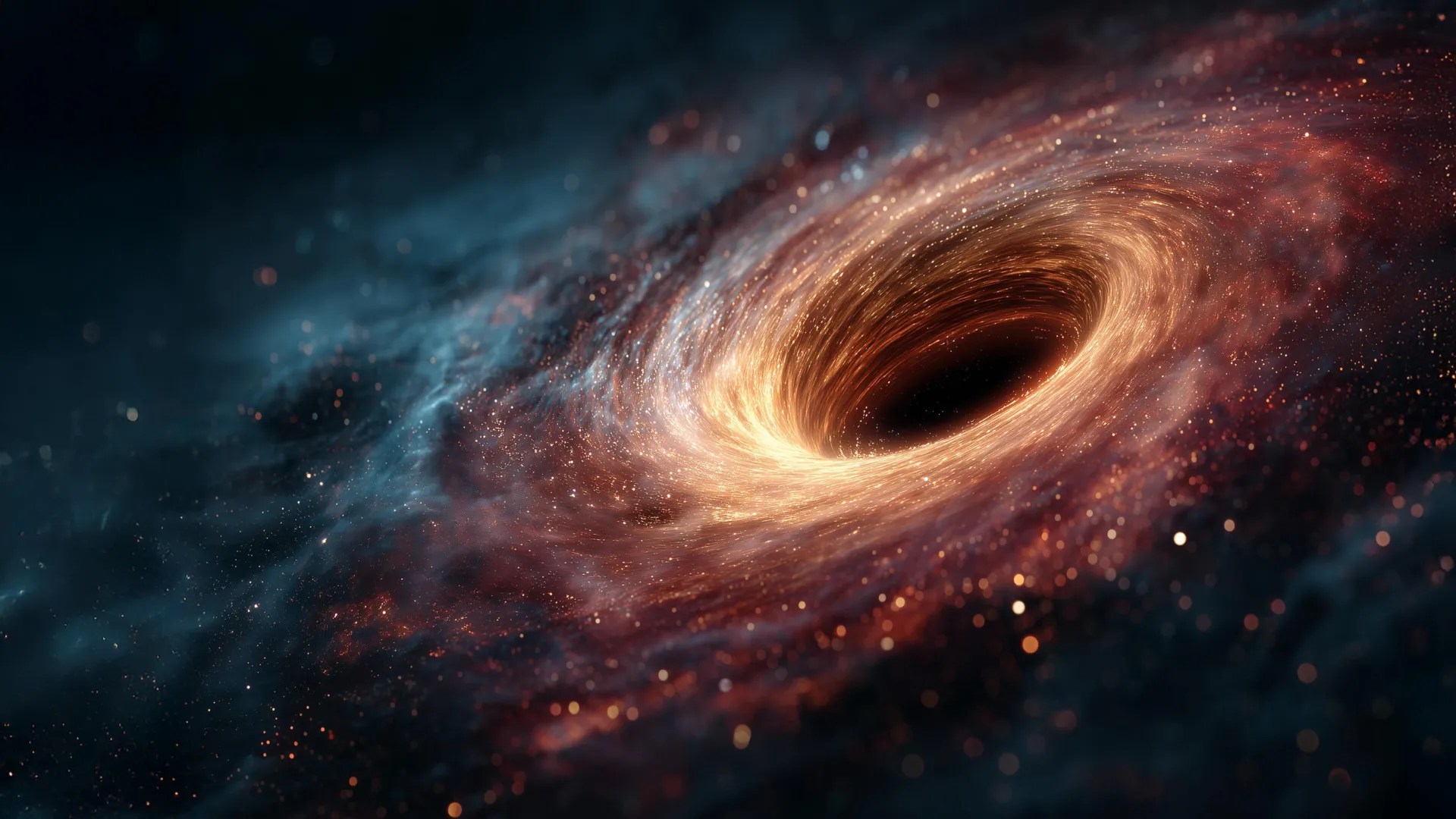
But here's where it gets controversial: The study focuses on quasars, those dazzling beacons of light first discovered in the 1960s. These objects are among the brightest in the cosmos, fueled by supermassive black holes devouring surrounding matter. As this material spirals inward, it forms a scorching, disk-shaped structure, emitting light 100 to 1,000 times more intense than an entire galaxy of 100 billion stars. This brilliance allows quasars to outshine their host galaxies, making them visible across vast cosmic distances.
The drama intensifies as ultraviolet light from the glowing disk interacts with highly energized particles in the black hole's corona, transforming into powerful X-rays. This process, long understood as a consistent cosmic relationship, has been a cornerstone for studying black hole environments. And this is the part most people miss: Astronomers have assumed that the link between ultraviolet and X-ray emissions is universal, implying that the structure of matter around black holes remains unchanged across time and space.
However, the new research reveals a surprising twist. By analyzing data from the eROSITA X-ray telescope and the European Space Agency's XMM-Newton observatory, the team found that when the universe was younger (around half its current age), the relationship between ultraviolet and X-ray light differed significantly from what we observe in nearby quasars today. This suggests that the interaction between the accretion disk and corona has evolved over the past 6.5 billion years.
Dr. Antonis Georgakakis, one of the study's authors, notes, 'Confirming a non-universal X-ray-to-ultraviolet relation with cosmic time is quite surprising and challenges our understanding of how supermassive black holes grow and radiate.' The team rigorously tested their findings, and the results appear robust.
This discovery has profound implications for cosmology. The assumed universality of the ultraviolet-X-ray relationship underpins methods that use quasars as 'standard candles' to map the universe and study dark matter and dark energy. If this relationship isn't constant, scientists may need to rethink their approaches.
Maria Chira, the study's lead researcher, highlights the methodological breakthrough: 'The eROSITA survey is vast but relatively shallow, detecting many quasars with only a few X-ray photons. By combining these data in a robust Bayesian statistical framework, we uncovered subtle trends that would otherwise remain hidden.'
Looking ahead, upcoming eROSITA all-sky scans will enable astronomers to observe fainter, more distant quasars. Coupled with next-generation X-ray and multiwavelength surveys, these observations could reveal whether the changes are due to physical evolution or data collection methods. Such efforts promise to deepen our understanding of how supermassive black holes power the universe's brightest objects and how their behavior has shifted over cosmic time.
Here’s a thought-provoking question for you: If the environment around black holes isn't as constant as we thought, what other cosmic assumptions might need reevaluation? Could this discovery reshape our understanding of the universe's fundamental laws? Share your thoughts in the comments—let’s spark a conversation!